
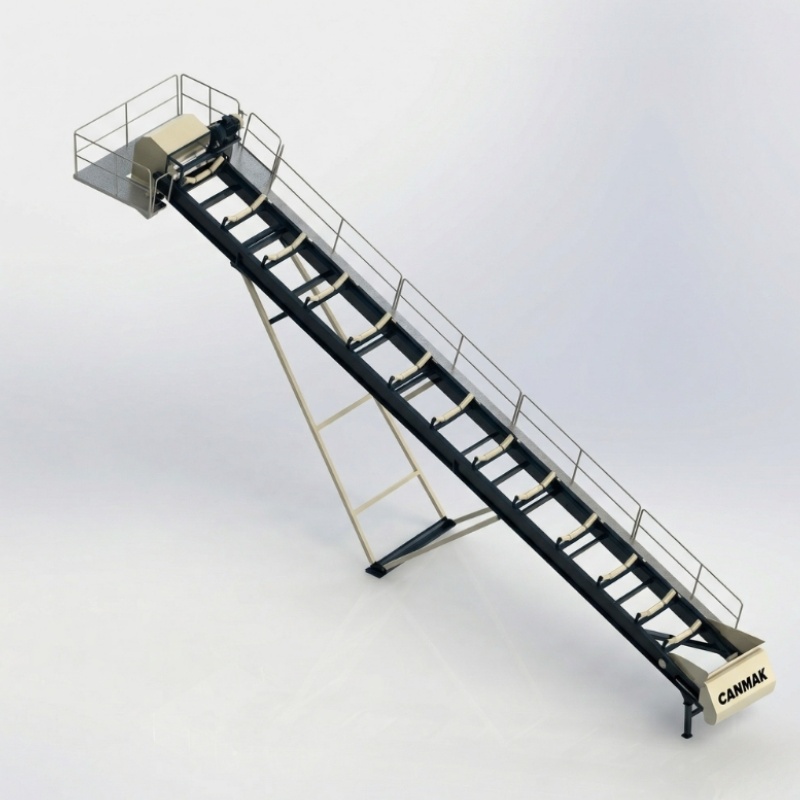
Conveyor Belts
Conveyor belts are material handling equipment that operate on the principle of continuously transporting material from one point to another in an uninterrupted and controlled manner through a continuously rotating belt system. The material is placed onto the belt at the feed point, and belt movement is provided through a drum driven by a geared motor. As the material advances on the belt surface, it is transported regularly along a predetermined path, while rollers and the chassis system maintain belt stability and linear motion. At the end of the process, the material is discharged in a controlled manner at the discharge point, ensuring continuity and operational efficiency in the production line.
Technical Specifications
| Structural Features | |
|---|---|
| Belt Structure | Rubber or PVC belt options |
| Frame | Modular steel construction |
| Drive System | Geared motor + drive drum |
| Roller System | Carrying and return rollers |
| Length/Capacity | Project-specific design |
| Performance | |
|---|---|
| Carrying Capacity | High-volume material transfer |
| Operating Continuity | Uninterrupted and stable operation |
| Energy Efficiency | Low energy consumption |
| Operation | Low maintenance requirement |
| Compatibility | Integrated with all crushing-screening systems |
Areas of Use
Crushing and Screening Plants
Ensures continuous material transportation between units
Ensures continuous material transportation between units
Mining
Provides highly efficient solution for ore and aggregate transportation
Provides highly efficient solution for ore and aggregate transportation
Aggregate and Sand Production
Regulates material flow in the production line
Regulates material flow in the production line
Industrial and Recycling Plants
Used in transporting different materials and process management
Used in transporting different materials and process management