 Türkçe
 English
 Arabic
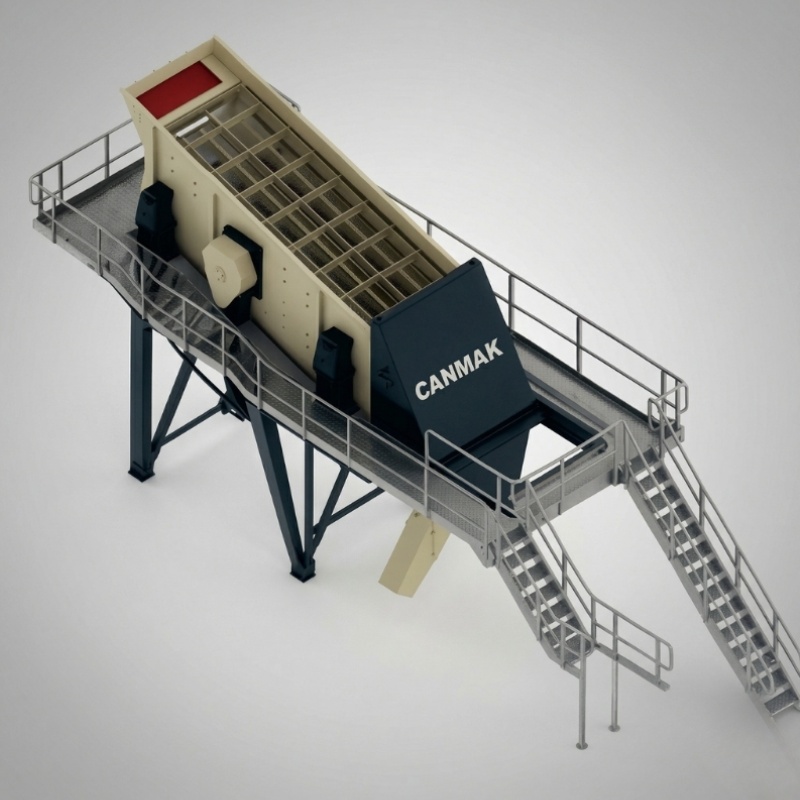
Horizontal Screens
Horizontal sieves are high-capacity screening systems that work on the principle of separating materials into different sizes by advancing material in a controlled manner over the screen surface through low inclination angle and high vibration motion. Material is distributed homogeneously onto the surface from the feeding section and advances regularly in the horizontal plane thanks to high amplitude vibration created by vibration motors or eccentric mechanisms. The multi-layered screen structure enables effective classification of material according to particle sizes, and each fraction is collected from separate discharge points. Through this system, the targeted granulometric distribution is obtained with precision, while process efficiency and product quality are continuously optimized.
Technical Specifications
| Structural Features | |
|---|---|
| Operating Angle | Horizontal — low slope (0–5°) |
| Number of Decks | 2, 3 or 4 deck options |
| Drive System | Vibration motor or eccentric mechanism |
| Body Structure | Heavy-duty durable chassis |
| Screen Surface | Replaceable screen wires/coatings |
| Performance | |
|---|---|
| Screening Efficiency | High separation precision in fine materials |
| Capacity | High-capacity operation |
| Material Distribution | Homogeneous and balanced screening |
| Vibration Force | High amplitude and frequency |
| Operation | Continuous and stable operation |
Applications
Enables precise separation of materials of different sizes
Provides high efficiency in fine and precision-sized aggregate production
Used in ore and mineral classification processes
Plays an effective role in separating different material types by size